
MENU
One of the topics that is frequently brought up with families I work with, is the Apgar test. Performed immediately after birth and without much fuss, most parents don’t even realize it’s happening. To be fair, the test is for the benefit of the baby, and the healthcare professional assisting the birth.

The moments after birth are busy ones! Whether at home or the hospital, making sure mom and baby are safe is the top priority. Apgar scores are provided one and five minutes after birth. Ocassionally, a third score will be provided after 10 minutes. The 1-minute score evaluates a newborn's tolerance to the birth process; the 5-minute score evaluates a newborn's adaptability to its surroundings, and its capacity to recuperate after birth. For most, the 1-minute score will be slightly (or sometimes significantly) lower than the 5-minute score. Each element of the test has a scoring scale of 0 – 2. Its purpose is to determine if there is a need for additional care within the first minutes after birth.
Most babies have an Apgar score between 7 – 10 points. Getting a full 10 points is extremely rare because most babies have slightly blue extremities immediately after birth. A “perfectly pink” baby is the exception, not the norm. Although some babies have lower scores (between 5 -7), they tend to bounce back within the time they are in the hospital.

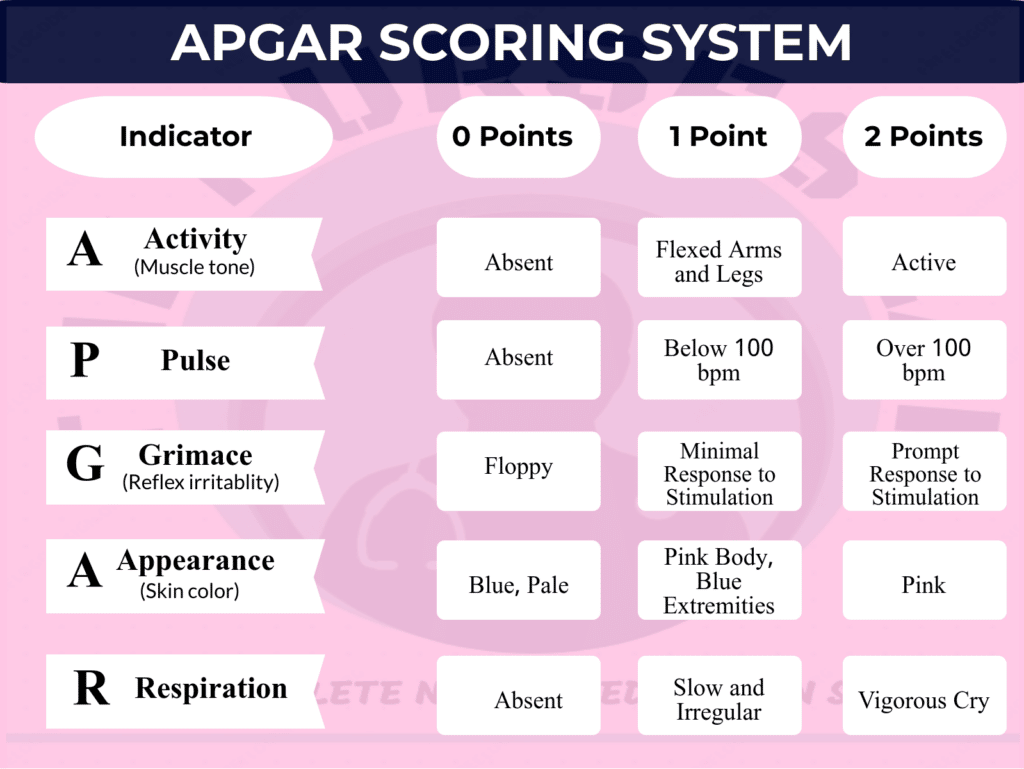
When creating the score, your baby's healthcare provider will examine the following aspects:
Appearance: : A baby’s skin color after birth says a lot about their circulatory system. The goal is to see properly perfused skin, indicating adequate oxygen levels and blood flow throughout the body.
Pulse: : A strong pulse indicates a healthy heart and its capacity to properly pump blood.
Grimace: : This score is achieved by examining a baby’s reflexive behaviour. There are different ways to do this. The most common things include: coughing, pulling away, crying when stimulated and facial expressions.
Activity ( muscle tone) : ): A moving baby is a good thing and it’s ideally what everyone wants to see. Some babies have more movement than others at birth and that’s okay. Again, it may take the baby a few minutes to become fully active.
Respiration: A vigorous cry will score a baby 2 points in this category. However, not all babies come out making their presence known. If a baby is born by C-section, they are more likely to need a bit of stimulation before that first loud cry. Why? A C-section doesn't provide the same stimulation to the lungs as a vaginal birth. During a vaginal birth, the pressure created helps release fluid from a baby’s lungs. Additionally, the effects from some of the birth hormones help the liquid in a baby’s lungs dry up faster.
Although knowing your child's Apgar scores is great, it's unlikely their overall health and long-term outcome will be based on those scores. As your baby grows, their doctor will determine health through growth, height, weight, milestones and many other things.


Our Top Ten Essentials for a Newborn

Connect with us

Connect with us